

A timing belt would NEVER be preferred by a gear head or an enthusiast.
They are, however, extremely common on automobile engines.
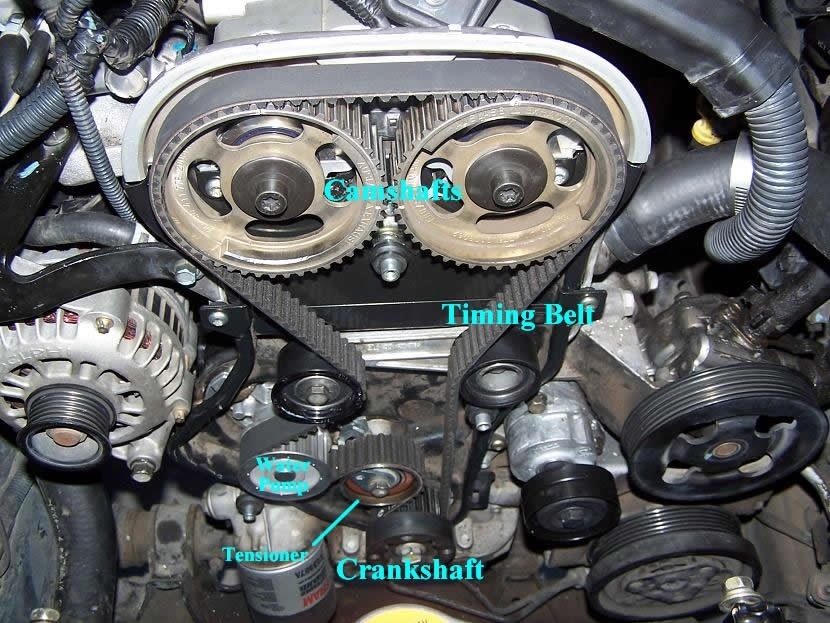
This is a typical engine timing belt.
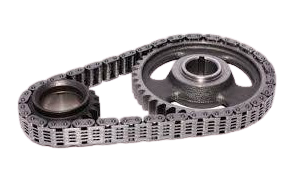
Compare this to a timing chain.
Or a timing gear system.
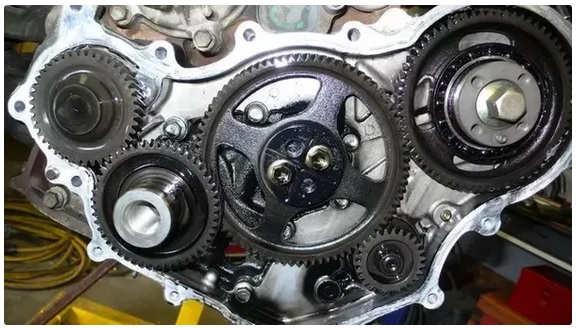
The timing belt has TWO advantages over the other systems.
IT IS CHEAPER…A LOT CHEAPER, TO MANUFACTURE.
In operation it runs more quietly than either a chain drive system or especially a gear drive system.
It is, after all, nothing more than a glorified toothed V-belt, not an assembled or machined part.
Timing belts are really cheap to make.
In that segment, price sells, and the usual customer in that market does not know, or care, what sort of an engine is located under the hood, and would not have any idea what you were talking about when you mentioned either timing belts or timing chains.
Controlling NVH (Noise, Harshness, and Vibration) takes engineering skill and is expensive.
Thus, we have come to associate quiet engines with high quality.
If a manufacturer is able to obtain that sound of quality with a cheap part, he is able to trick the uninformed customer into thinking that the car is built to higher standards than is in fact the case.
For the manufacturer, what is not to like?
Let me give you a bunch of reasons: Timing belts break.
They are rubber and fiber parts that deteriorate, especially in the presence of oil and fuel and heat.
And guess what you find in an engine compartment…oil and fuel and heat.
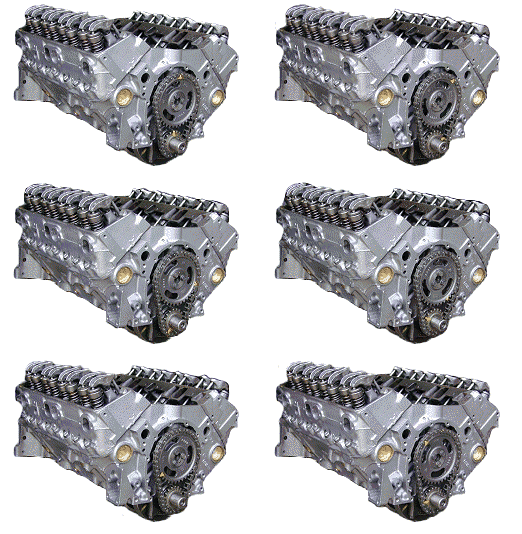
Moreover, when they do break, if you have an interference engine, something like this happens
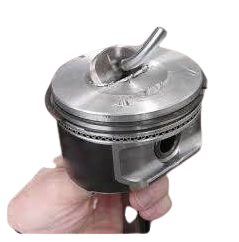

The engine can be damaged so catastrophically that repair is not financially reasonable. You will have to buy a new engine.
Timing belts are cheap to make but expensive to own. Because all timing belts will eventually fail, and that failure can lead to catastrophic engine damage, they have to be periodically replaced.
The recommended replacement schedule for timing
belts is generally
96 thousand km to 160 thousand km and/or five to seven years.
General life-span for Cambelts is as follow:
80,000 km (ie. ALFA)
90,000 km (ie. VW, HYUNDAI, Kia, Opel, Peugeot, Nissan)
Up to 120,000 km(ie.Toyota D4D),
180,000 km (ie. audi A6) .
And the service needed to replace a timing
belt is very expensive .
That is not because the belt is expensive. It is a cheap part.
However, the number of components the mechanic has to
remove just to get at the timing belt requires a lot of expensive labour hours.
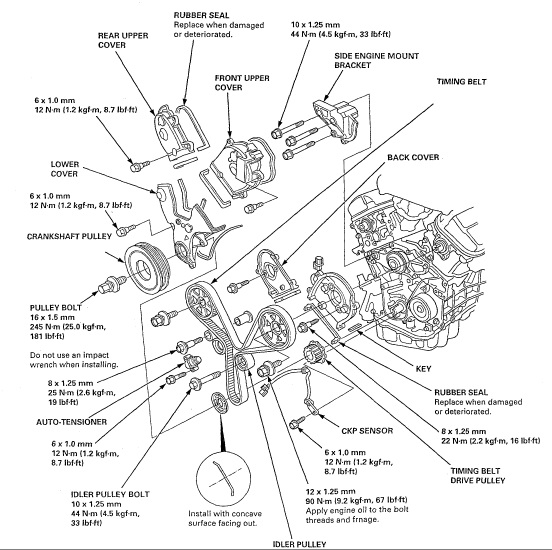
These
are just SOME of the parts surrounding the timing belt.
Many of them are hard to access because of the position of the engine in the car.
But timing chains and gears break too, right?
In all my years of working on engines I HAVE NOT EXPERIENCED ONE TIMING
CHAIN OR TIMING GEAR FAILURE.
Although it is possible, if an owner has really abused a car and has driven it way beyond its expected lifespan, timing chain and gear failures are very uncommon.
Every one of which I
am aware was caused, not by a failure of the timing chain, but rather because of another cheap part installed on a low end engine by a manufacturer.
Some manufactures chose to use fiber timing gears such as these.
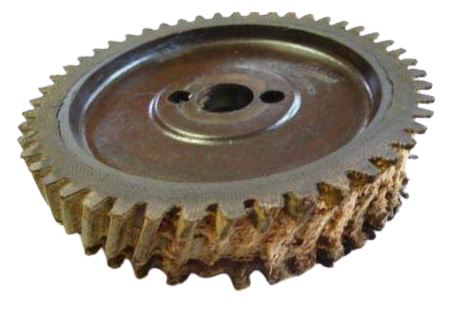
This one is from a Ford, but fiber timing gears were installed through the 1970’s and probably later. They were chosen because they ran more quietly than machined metal gears. But they did deteriorate. And when they did they would chew off their own teeth.
The only other timing chain failures of which I am aware were caused by the use of plastic chain guides in an engine that when worn could cause problems. The design was changed and all of those engines had those guides replaced with machined metal parts.
Chains can stretch, and if the chain guides or tensioners are absent or worn there can be problems. But an advantage chains have over belts is that you will be forewarned of a possible chain failure before damage occurs. Belts can fail abruptly and without warning, long before the engine is anywhere near the end of its service life. And that belt failure can cause catastrophic damage. Every mechanic recognizes the distinctive sound made by a loose chain. If you have your car properly serviced, he will recognize that sound and warn you so that you can have the car serviced before damage occurs.
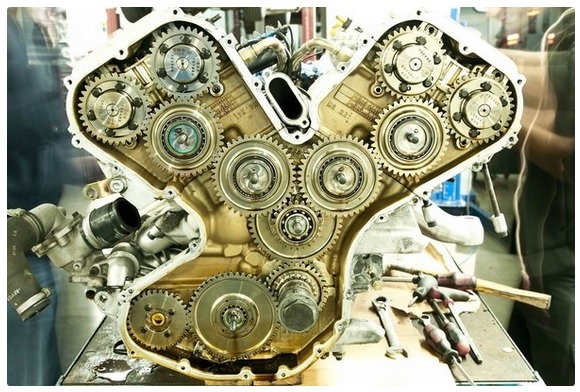
The best engines employ gear drives or gear and chain drives for the camshafts.
As for the greater noise made by chain and gear drives? For a gear head the sound made by the gear drives of a Ferrari is heavenly!
They had a customer bringing a car in with a seized engine, trying to get it repair under warranty.
The car had about 60,000 kilo-metres on it, the customer had bought the car from them new.
When they checked the engine, they removed the sump and found the oil had turned into a tar like substance.
When speaking to the customer they asked him when and where he had his servicing done, as they had no record of it.
It turned out that the customer never had the car serviced from the day he picked it up.
After some careful questioning, the customer revealed that when he picked up the car the salesman never said anything about the car required servicing, so he assumed it didn’t need servicing.
Warranty declined to pay for the replacement engine on the grounds that the engine wasn’t faulty.
The customer paid for the new engine, with a heavy discount on both parts and labour as a good will gesture.
So to answer the question, in this case about 60,000 kilo-metres.
Change your oil, put those spark plugs, keep your tires inflated properly, use the recommended octane of fuel for your engine, etc.
Your car will return better mileage if it is operating properly and you have completed your preventive maintenance.
Take extra weight out of your car. Stop carrying things around you don’t need to carry around.
Drive slower. Follow the speed limits. Driving slower saves fuel.
Most cars have a sweet spot somewhere around 64km/h where you get the best fuel returns.
It’s where the transmission is in the highest gear and (for automatics) the torque converter has locked up.
You are enough above the shift and lockup point that the transmission isn’t hunting.
Once you start driving above around 90km/h, your mileage will start dropping due to wind resistance.
Accelerate within 10 seconds to 60km/h, however in town where you have to stop frequently it is better to accelerate slower within 30 seconds to 60km/h and avoid stopping. Having to accelerate again because you had to slow down wastes fuel.
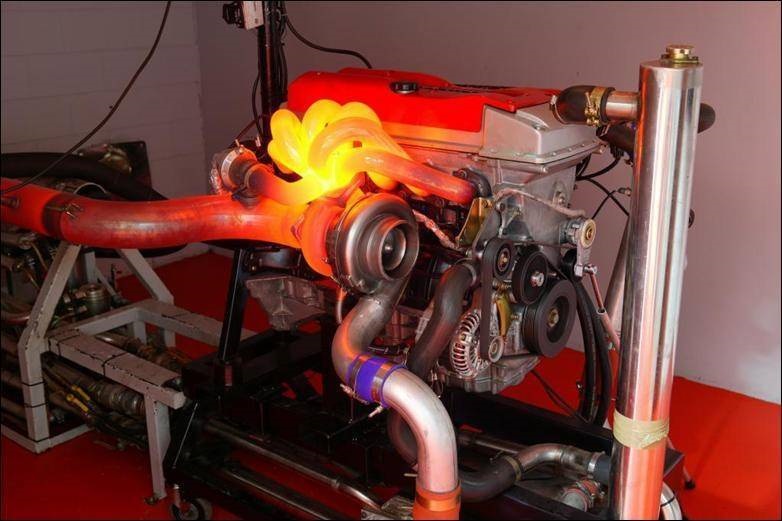
It is therefore recommended that if your car has a turbo engine, after a ride pushing the engine to its limits, you complete 3–5 kilometers to cool down the engine.
Then let it idle for at least three(3) minutes before turning off.
In the case your car does not have a turbo, you don’t have to worry about it, as its fans do their job fairly well (as long as you have a working battery of course).
However, it is never good for an engine such abrupt change in temperature, regardless of its components.
I’ll let you in on a secret.
All those fancy spark plugs like platinum and iridium were designed for one real purpose: to extend tune up intervals due to the more difficult process of changing spark plugs on modern vehicles.
These metals are harder and last longer, making the replacement interval about 160,000 kilometers.
You know what kind of plugs most fast tuned street cars use?
Old school copper tip plugs at the cheaper price.
They won’t last 160,000 kilometers but you’ll get a little more power and better mileage out of them due to being a softer metal that gives a stronger spark.
I would say that magnets around a filter housing would have the same effect and sounds like a good idea.
It certainly can’t hurt anything.
In the past it was pretty much a given
that vehicles with manual transmissions would be more fuel-efficient
than their automatic counterparts. But as automatics become more
advanced and gain additional gears (eight-speed transmissions are fairly
easy to find), they are often now overtaking manuals in terms of fuel
economy.
.
For an example of when the myth is based in reality, there’s the fuel-sipping 2014 Chevrolet Cruze Eco.
The manual version of this small Chevy gets 5.986 l/100km combined
(5.078 l/100km mpg in the city/7.618 l/100km on the highway). Equipped
with an automatic transmission, the Eco is slightly less fuel-efficient:
5.623 l/100km combined (4.716 city/7.074 highway). The manual will cost
you about R1500 less per year in fuel.
.
With the 2014 Ford Focus,
it’s the six-speed automatic version that performs better, getting
5.623 l/100km combined (4.898 city/6.711 highway). If you spring for the
Super Fuel Economy option package, which also uses the six-speed
automatic transmission, fuel economy rises to 5.986 l/100km combined
(5.079 city/7.256 highway). A Ford Focus with a conventional manual
transmission can’t match the automatics. It gets 5.44 l/100km combined (4.716 city/6.53 highway).
.
There are other examples as well. For the 2014 Versa, Nissan actually
offers three transmissions: a five-speed manual, a four-speed automatic
and a continuously variable transmission (CVT). The manual and automatic
get the same combined fuel economy (5.441 l/100km), but the CVT blows
both of them away at 6.349 l/100km combined. And it’s not just economy
cars where you can find this trend: A 2013 BMW 328i sedan will get the
same combined fuel economy (4.716 l/100km) whether you opt for the manual or the automatic transmission.
A Continuously Variable Transmission (CVT), also known as a shiftless transmission, single-speed transmission, stepless transmission, pulley transmission, or, in case of motorcycles, a ‘twist-and-go’, is an automatic transmission that can change seamlessly through a continuous range of effective gear ratios.
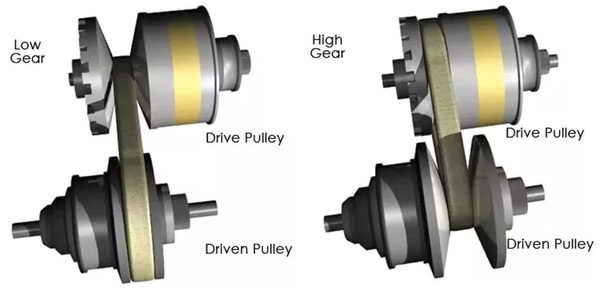

Thats right. CVT’s were BANNED from formula
one competitions. That should tell your something about the
misconceptions about these things. The key feature is their ability to be electronically tuned.
We find CVTs in a bunch of teensy Japanese econoboxes because they can
so easily be tuned to maximize fuel economy. However, we can just as
easily tune these things so that they maximize power. The ability to be at 100% power, all the time was just too much of an advantage and the technology was banned from formula one competitions before the Williams
prototype made a single lap.
(Find out more about CVT at “Road & Track” website).
Then comes the natural question, why does every gasguzzling
horsepower-injected tire-burning hot rod not have a CVT? The only good
reason is tradition. People like to take their barking V8 up to redline
in second gear, to be able to tap the left shift paddle on a turn and
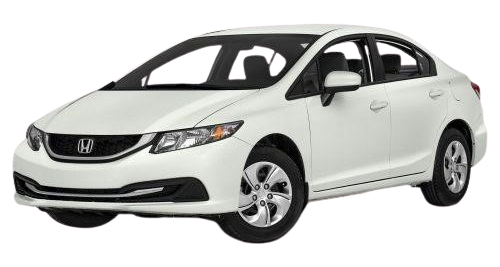
barely hold on to the road. Anybody who’s driven a Honda civic knows
that you get just about… none of that. But eventually, as these sports
cars get choked by emission standards, they are going to have to bite
the bullet and trade in the gears for the far better belts and cones.
But for now, I’ll drive whatever kind of transmission comes in most fun
cars.
In the US, trailers have a max length of 16 meters. There is no limit on the length of the truck as a whole.
Therefore, most US truckers prefer to drive ‘conventional’ rigs, with the engine in front of the driver. They are safer in accidents, more comfortable, easier to service, and quieter than ‘cab over’ tractors.
In South Africa, they limit the overall length of the vehicle, so it makes sense to use the shortest possible tractor, so the trailer can be as long as possible. You used to see ‘cab over’s’ in the USA used by long haul truckers, but seldom see them in that application anymore. They are still popular for city/suburban uses, as their shorter length makes turning easier.
So, one little regulation difference means a different selection of equipment. The law of unintended consequences.